The Historical Construction of Male Identity
The idea that there exists a singular, timeless definition of what it means to be a man is one of the more persistent historical errors in popular thinking about gender. Empirical examination of the historical record — across archaeology, social history, literary analysis, and anthropology — reveals an enormous diversity of expectations, ideals, and structures governing the lives of men across different societies and periods. This diversity is not a modern discovery; historians and social scientists have been documenting it for generations. The persistence of the opposing belief reflects the strength of cultural narratives rather than the weight of evidence.
Understanding how male roles have been constructed historically serves several purposes. It contextualises the present — demonstrating that current norms are particular rather than universal. It reveals the mechanisms by which gender expectations are produced and reproduced. And it provides perspective on the degree to which individuals and societies have, at different moments, found different answers to the enduring questions of how men should relate to one another, to women, to labour, to authority, and to themselves.
Comparative Context: Masculinity Across Eras and Regions
Greece & Rome
Civic virtue, martial honour, and philosophical self-mastery defined masculine ideals — though these existed alongside significant variation in practice.
European Chivalry
Knightly codes combined martial prowess with courtly deference, religious piety, and codes of honour binding men to hierarchical obligations.
Southeast Asian Traditions
Male identity was embedded in obligations to community, family lineage, and spiritual practice within socially stratified kingdoms and sultanates.
19th-Century Europe
Industrial capitalism reoriented masculine identity around productive labour, breadwinning, and the separation of public and domestic spheres.
Post-War West
The mid-century period consolidated the provider-protector model, while subsequent decades saw sustained challenges to its assumptions from multiple directions.
Pluralist Context
No single definition commands universal acceptance. Multiple frameworks coexist, often in tension, within and across societies.
Classical Antiquity: Virtue, Restraint, and Civic Duty
In ancient Greece, the ideals governing masculine conduct were centred not on emotional hardness or physical dominance alone, but on the concept of virtue — arete — understood as excellence in the fulfilment of one's social function. The warrior virtues of courage and physical capability were highly valued, but they were understood to require the governance of reason. A man who could not control his passions was not considered fully excellent, regardless of his physical prowess. Plato's dialogues repeatedly return to the relationship between self-mastery, rational governance of desire, and the capacity to function well in public life.
In Rome, masculine identity was organised substantially around the concept of virtus — a term etymologically connected to the Latin vir, meaning man — which encompassed courage, moral seriousness, civic commitment, and the authority to command. Roman masculinity was deeply hierarchical: the paterfamilias held legal and social authority over his household, and public masculine virtue was exercised in relation to civic and military life. Yet Roman philosophers, particularly the Stoics, developed rich accounts of the inner life that complicated the simple equation of masculinity with external dominance, emphasising instead the governance of one's own responses and the cultivation of equanimity.
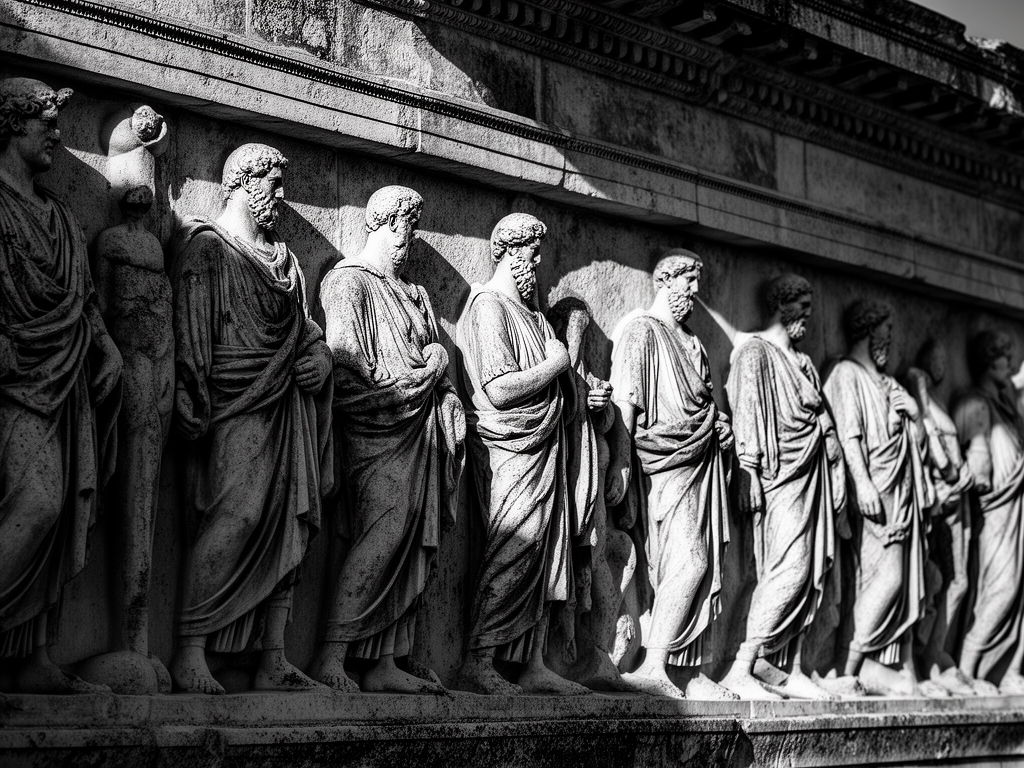
Classical reliefs offer visual evidence of how societies represented masculine virtue and social order in monumental form — communicating ideals across generations without text.
Pre-Colonial Nusantara: Community, Lineage, and Spiritual Obligation
In the archipelago that now constitutes Indonesia, masculine identity in pre-colonial and early colonial periods was structured by a complex interplay of social hierarchy, spiritual obligation, and community responsibility. In the court cultures of Java, Bali, and the Malay world, masculine ideals were connected to the refinement of bearing and speech — alus, the quality of being refined, civilised, and controlled — as much as to physical capability. The capacity to contain and direct one's inner forces, rather than to express them dramatically, was a marker of masculine status in elite contexts.
At the community level, the organisation of male responsibility around the obligations of family, agricultural cooperation, and mutual aid — gotong royong, the principle of communal assistance — shaped a conception of masculine identity rooted in relational accountability rather than individual achievement. This stands in considerable contrast to the more individualist models of masculine achievement that dominated European accounts of the same period and that were exported through colonial contact.
The regional examples cited in this article are necessarily brief and generalised. The histories of masculine identity in Javanese, Sundanese, Batak, Bugis, Balinese, and other Indonesian societies are each richly specific. This article aims to indicate the diversity and contextual specificity of these histories, not to offer a comprehensive account of any of them.
The Industrial Transformation and Its Legacy
The industrialisation of European and North American economies across the nineteenth century produced one of the most significant reorganisations of masculine identity in the modern period. The shift from craft-based and agricultural labour to factory work, and the associated separation of workplace from home, created the structural conditions for what historians sometimes call the breadwinner-homemaker model — in which masculine identity became closely tied to paid productive work outside the home, and feminine identity to unpaid reproductive and domestic labour within it.
This model, which is often mistakenly described as traditional or natural, was in fact a historically specific product of particular economic arrangements. It was unevenly applied across class, racial, and regional lines, and was contested even as it was being consolidated. Nevertheless, it shaped the normative framework within which masculine identity was understood across much of the twentieth century, and its residue remains clearly visible in contemporary attitudes and expectations.
The post-war period in Western societies saw a further consolidation of this model, as the economic boom years of the 1950s and early 1960s created material conditions in which the male breadwinner ideal was achievable for a wider proportion of the population than at any previous point. The subsequent decades of social change — the women's movement, shifts in the labour market, and changes in family structure — challenged this model without fully replacing it, producing the complex, contested landscape of masculine identity that characterises the present.
Reading the Present Through the Historical Record
The value of historical perspective on male roles is not primarily retrospective. It does not serve mainly as a record of how things used to be. Its more significant function is analytical: it demonstrates, with the specificity of concrete examples, that the categories through which masculine identity is currently understood are contingent rather than necessary — products of particular historical trajectories rather than expressions of universal human nature.
This does not mean that current norms are arbitrary or that all arrangements are equivalent. It means that they can be examined — their origins traced, their functions understood, their costs and benefits assessed — with a degree of intellectual clarity that is simply unavailable when they are taken as given. For anyone seeking to understand how masculine identity is constructed, maintained, and negotiated in contemporary societies, the historical record is an indispensable resource.